

How to Store Wine in Singapore: Storage Guide & Tips
Wine Storage in Singapore: What Happens Between the Reefer and the Cellar
Most wine storage comparisons stop at the cellar door: the room temperature and the monthly fee. In Singapore, the journey into the cellar deserves equal attention.
A refrigerated container protects wine at sea. A chilled cellar protects it in storage. The handover between the two decides whether the protection holds.
This guide explains where heat exposure occurs during receiving, what to ask any storage provider, and how Singapore Wine Vault handles each stage.
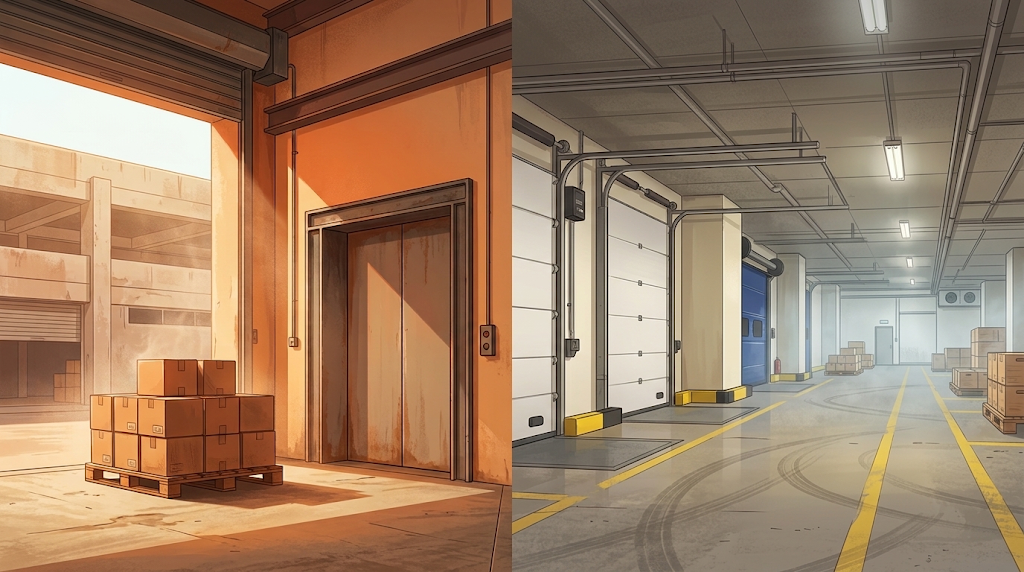
Why heat exposure during transfer matters
Wine keeps developing after bottling, and temperature sets the pace.
A 2019 study by The Australian Wine Research Institute found even modest differences in storage temperature had a measurable effect over time. The wine kept warmer lost sulphur dioxide, its main protection against oxidation, faster than the wine kept cool. It also showed colour and phenolic changes consistent with faster ageing.
Short, intense exposure carries its own risk. A review published in OENO One recommends keeping trans-shipment stages to a minimum, especially in hot climates, and limiting time spent in the destination port. The authors note elevated temperatures during storage or transport change a wine’s chemical and sensory profile irreversibly. Returning a warmed case to a cold room does not undo the change.
The effects vary with the wine, its closure, its packaging and the length of exposure, and no single threshold applies to every bottle. The sound approach is prevention: keep wine out of the heat at every handover.
The weak point: open docks and cargo lifts
Daytime temperatures in Singapore regularly exceed 30°C.
In a typical multi-storey warehouse, wine arriving by reefer container unloads at a loading bay open to ambient conditions. Pallets then wait for a cargo lift, travel up, and wait again on the storage floor before put-away. With shared lifts and other cargo in the queue, every wait adds time in tropical heat.
None of this appears on a storage quotation. The reefer held its setting and the cellar holds its temperature, while the exposure happens in between.
How Singapore Wine Vault receives wine
At Singapore Wine Vault, reefer containers discharge into a temperature-controlled staging area. Cases move from the container into controlled conditions for inspection and tallying, then into storage. The wine never waits at an open dock or in a cargo lift queue.
Once inventory is recorded, clients see their holdings in SWVButler, our client app.
Storage conditions: 12°C ± 0.5°C, 60% to 70% humidity
Fine wines at Singapore Wine Vault are stored at 12°C ± 0.5°C, with relative humidity maintained between 60% and 70%.
A stated tolerance matters as much as the set point. It shows how tightly a provider holds its conditions, not only where it aims them.
Audited management systems: ISO 9001, ISO 14001 and ISO 45001
Singapore Wine Vault’s operations are certified to three standards:
- ISO 9001 for quality management
- ISO 14001 for environmental management
- ISO 45001 for occupational health and safety
For customers, certification means documented procedures, trained staff, reliable records and corrective action, all subject to independent audit.
ISO certification does not set a storage temperature or guarantee preservation. Its value lies in accountability. When comparing providers, ask which standards apply and which sites and services each certificate covers.
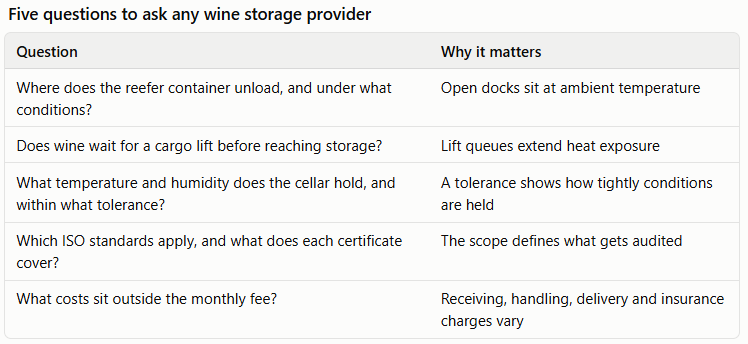
Similar fees do not mean similar handling.
Talk to our team
If you are planning an incoming shipment or moving a collection, contact Singapore Wine Vault. Our team will explain how your wine moves from container to cellar, and the storage arrangements suited to your collection.
Recent Blogs

Wine Storage in Singapore: What Happens Between the Reefer and the Cellar
Most wine storage comparisons stop at the cellar door: the room temperature and the monthly fee. In Singapore, the journey into the cellar deserves equal attention. A refrigerated container protects wine at sea. A chilled cellar protects it in storage. The handover between the two decides whether the protection holds. This guide explains where heat […]
Singapore Wine Vault’s Guide to Bonded Wine Storage: Duty, GST Deferral & When You Need It
Most wine collectors do not realise it, but many are quietly paying import duty and GST on bottles that they may never actually drink or sell in Singapore. The moment your wine clears customs into regular storage, your tax bill will be locked in regardless of whether your bottle is opened next month or held […]
Wine Logistics Singapore: Bonded Storage, Transport & Compliance Guide
Bonded wine storage in Singapore is a customs-licensed storage arrangement that suspends duty and GST on wine until it is released for sale or consumption. Thus, this helps wine collectors and F&B businesses store valuable, temperature-sensitive wine without paying duty and GST upfront, all while maintaining its quality. This is where bonded wine storage in […]